


A North County San Diego Property Owner's Guide to Choosing the Right Property Manager
By FPM Group | Carlsbad, California
If you've recently searched Google or asked ChatGPT to recommend the best property management company in Carlsbad, Encinitas, Oceanside, or anywhere in North County San Diego, you've probably received a convenient list of highly rated companies.
Maybe you saw a few five-star reviews, a comparison of management fees, and a recommendation for the "best" property manager in your area.
But here's the problem: The company that ranks highest online isn't necessarily the company that will do the best job managing your investment property.
Choosing a property manager isn't like comparing prices on a new television. You're hiring someone to protect an asset worth hundreds of thousands—or potentially millions—of dollars.
The right property manager can help minimize vacancies, secure qualified tenants, maintain your property, and provide financial transparency. The wrong one can cost you thousands through extended vacancies, poor screening, unexpected fees, and inadequate communication.
At FPM Group, we believe property owners should evaluate management companies based on what actually matters: performance, communication, transparency, and long-term financial results.
Here's how to make that comparison.
Why AI-Assisted Searches May Be Pointing You Toward the Wrong Companies
Technology has completely changed how property owners find management companies.
Not long ago, finding a property manager meant asking another landlord for a referral, looking for signs around the neighborhood, or researching local companies individually.
Today, an AI-powered search can generate a list of recommendations in seconds.
Convenient? Absolutely.
Comprehensive? Not necessarily.
Research from Harvard University's Joint Center for Housing Studies demonstrates just how fragmented the property management industry really is.
A June 2026 working paper by researcher Whitney Airgood-Obrycki identified nearly 12,000 property management companies nationally within the larger-property market segment covered by Yardi Matrix.
And that doesn't include the entire universe of smaller residential property managers specializing in single-family homes, condominiums, and smaller multifamily properties.
Meanwhile, the U.S. Bureau of Labor Statistics reported approximately 460,400 jobs in property, real estate, and community association management in 2025.
The industry is enormous, yet an AI search may narrow your options to just a handful of companies.
Why do certain property management companies appear more frequently?
AI recommendations and traditional search rankings are influenced by factors such as online visibility, available website content, review volume, and the information search engines can access.
Those characteristics don't necessarily reflect how effectively a company manages rental properties.
Research from BrightLocal's 2026 Local Consumer Review Survey found that the percentage of consumers using AI tools for local business recommendations increased from 6% to 45% in just one year.
More consumers are relying on technology to make important purchasing decisions, but that doesn't mean the technology can accurately evaluate the quality of a property management company's operations.
A company with a sophisticated marketing strategy may appear more frequently in search results than a smaller, locally focused company providing exceptional service.
The takeaway: Use AI and Google to identify potential property managers, but don't let an algorithm make the final decision about who manages your investment.
The Metrics That Can Mislead Property Owners
When comparing property management companies, most owners naturally gravitate toward a few easy-to-understand numbers.
Unfortunately, those numbers rarely tell the whole story.
1. The Lowest Monthly Management Fee
When comparing property management companies, the monthly management fee is often the first number property owners look at. And understandably so—everyone wants to maximize the return on their investment.
But here's something worth considering: The lowest monthly fee doesn't always represent the best value, and the highest fee doesn't necessarily mean better service.
Property management companies structure their pricing differently. Some charge a higher monthly percentage and bundle additional services into that fee. Others offer a lower ongoing management fee and charge separately for services such as leasing, lease renewals, and maintenance coordination.
Neither approach is inherently better. What matters is understanding what you're paying for and whether the services being provided deliver value.
According to ClearLeadDigital's analysis of property management fees, residential management fees commonly range from 8% to 12% of monthly rent, with leasing fees, renewal charges, and maintenance coordination often billed separately.
And as Hey Jodie's guide to property management pricing explains, some companies offer flat monthly fees or hybrid pricing structures, making direct comparisons based on management percentages alone even more challenging.
Why an Itemized Fee Structure Can Benefit Property Owners
Consider a rental property generating $4,500 per month with two hypothetical management companies.
Company A — Itemized Pricing
Monthly management fee: 8%
Leasing fee: 50% of one month's rent
Lease renewal fee: $250
Maintenance coordination: 10% of repair costs
Company B — All-Inclusive Pricing
Monthly management fee: 10%
Leasing, renewals, and maintenance coordination included
Now consider a year in which the existing tenant remains in place, renews the lease, and the property requires $2,000 in maintenance.
| Expense | Company A | Company B |
|---|---|---|
| Annual management fees | $4,320 | $5,400 |
| Leasing fee (no turnover) | $0 | Included |
| Lease renewal | $250 | Included |
| Maintenance coordination | $200 | Included |
| Total annual fees | $4,770 | $5,400 |
In this example, Company A saves the property owner $630 over the course of the year.
And in a year without a tenant turnover, lease renewal, or maintenance expenses, the savings would be even greater—$1,080 annually.
Of course, if the property requires a new tenant, the calculations change. That's why it's important to compare multiple scenarios rather than focusing exclusively on the first year of management.
The advantage of an itemized fee structure is that owners pay for certain services when they're actually needed, rather than paying a higher monthly percentage regardless of how much additional work the property requires.
But Here's the Bigger Picture: The Cost of Vacancy Can Dwarf the Difference in Management Fees
Let's say your property rents for $4,500 per month.
That's approximately $150 per day in potential rental income.
If one management company takes an additional 30 days to secure a qualified tenant, that's approximately $4,500 in lost rental income—far more than the annual difference between these two companies' monthly management fees.
Likewise, placing an unqualified tenant can result in unpaid rent, property damage, legal expenses, and extended vacancies.
This is why BiggerPockets' discussion of red flags when hiring a property manager encourages owners to look beyond pricing and evaluate the quality of the management company itself.
A management company that charges a reasonable fee, screens tenants thoroughly, responds promptly to maintenance requests, and works to minimize vacancies may ultimately deliver significantly better financial results than one advertising the lowest rate.
How FPM Group Approaches Pricing
At FPM Group Property Management, our standard monthly management fee is 8%, with leasing, lease renewals, and maintenance coordination priced separately.
We believe this approach provides owners with a transparent, straightforward fee structure where the cost of additional services is tied to the work being performed.
Rather than building every possible service into a higher monthly percentage, we clearly outline our fees upfront so owners understand exactly what they're paying for.
But we also recognize that the real measure of a property management company's value isn't simply how much it charges—it's how effectively it protects and performs for your investment.
Our focus is on securing qualified tenants, minimizing unnecessary vacancies, maintaining properties responsibly, and providing clear communication and financial reporting.
When comparing management companies, ask for a complete fee schedule, calculate costs across both turnover and renewal years, and—most importantly—evaluate the company's actual management practices.
Because at the end of the day, the goal isn't simply to find the cheapest property manager.
It's to find the property manager who helps you keep more of your rental income while protecting the long-term value of your property.
2. Online Star Ratings and Review Counts
Online reviews can provide valuable insight into a company's reputation.
However, a five-star rating doesn't automatically mean a company will be the best fit for your property.
Consider the difference between a company with twelve five-star reviews and another with hundreds of reviews averaging 4.6 stars.
Neither rating tells you how quickly vacancies are filled, how thoroughly tenants are screened, or how accurately financial statements are prepared.
Read the actual reviews rather than focusing exclusively on the overall rating.
Look for recurring comments about communication, maintenance responsiveness, tenant placement, and problem resolution.
3. Proximity and Search Engine Placement
Just because a property management company appears first in a Google search doesn't mean it's the most qualified.
Likewise, the closest office isn't necessarily the best choice.
Local market knowledge matters, particularly in North County San Diego, where rental conditions can differ significantly between coastal Carlsbad, Encinitas, Oceanside, Vista, and San Marcos.
But proximity alone doesn't guarantee quality.
Look for a company that understands your property's specific market and has the systems necessary to manage it effectively.
The Metrics That Actually Matter When Choosing a Property Manager
California's Department of Real Estate publishes a consumer resource titled Quick Guide for Landlords Hiring a Property Manager.
It encourages owners to investigate a company's licensing, experience, tenant screening practices, staffing, vacancy performance, accounting procedures, and management agreement.
These are excellent starting points.
Here are the areas we believe deserve the most attention.
1. How Many Days Does Your Property Sit Vacant?
Vacancy is one of the most expensive challenges rental property owners face.
Every day your property sits empty represents income you cannot recover.
Consider a rental property generating $4,500 per month.
That's approximately $150 in potential rental income every day.
If one property manager fills a vacancy in 15 days while another takes 45 days, the difference is substantial.
Thirty additional vacant days could cost you approximately $4,500 in lost rental income.
That amount alone could outweigh years of savings from a slightly lower management fee.
When interviewing a property management company, ask:
"How many days does a property typically sit without generating rental income between tenants?"
Ideally, the company should track the entire turnover process, including inspections, repairs, marketing, showings, application processing, and tenant placement.
Keep in mind that results depend on the property's condition, asking rent, seasonality, and market conditions.
A good manager should explain how they minimize vacancy without sacrificing tenant quality.
2. How Thoroughly Are Prospective Tenants Screened?
Finding a tenant is relatively easy.
Finding a qualified tenant who pays on time, maintains the property, and fulfills their lease obligations requires a disciplined screening process.
Poor tenant placement can create significant financial and legal headaches.
When interviewing property management companies, ask about their screening criteria and how consistently they apply them.
At FPM Group, our standard applicant screening process includes credit review, income verification, rental history, and background screening where legally permitted.
Our general criteria include a minimum credit score of 650 and verifiable income of approximately 2.5 times the monthly rent, subject to applicable law and required accommodations.
We also require adult applicants to complete the application process.
For California rental properties, screening must comply with fair housing laws, applicable source-of-income protections, and other legal requirements.
The goal isn't simply to fill the vacancy quickly. It's to place a qualified tenant while treating applicants fairly and consistently.
Ask prospective management companies how they verify income, check rental references, handle incomplete applications, and measure eviction outcomes.
A company should be able to explain its screening procedures clearly.
3. Communication Systems Matter More Than Communication Promises
Every property management company claims to provide excellent communication.
But what does that actually mean?
Does the company provide regular updates? Can owners access financial information without requesting it? Are maintenance requests tracked? Who responds when something goes wrong?
These questions are far more revealing than a promise of great customer service.
At FPM Group, we use Rentvine property management software to organize important aspects of the management process.
Our system provides owners with access to financial statements and property information through an online portal.
Tenants can submit maintenance requests through their portal, helping keep repair issues documented and organized.
When evaluating another company, ask to see the actual owner portal and a sample monthly financial statement.
Ask how maintenance requests are submitted, who coordinates vendors, and when owners are notified about significant repairs.
A good property management company should have repeatable systems—not just good intentions.
4. Financial Transparency and Trust Accounting
Your property manager is responsible for handling rental income, security deposits, vendor payments, and other financial transactions.
You should understand exactly how your money is managed.
California's Department of Real Estate specifically recommends reviewing a property manager's trust accounting practices and requiring monthly accounting reports.
Ask prospective companies how they separate client funds from operating funds, how frequently owners receive statements, and how maintenance expenses are documented.
At FPM Group, we maintain designated property management trust accounts and use Rentvine to track property-related income and expenses.
Owners should be able to review their financial performance without chasing down basic information.
Financial transparency isn't an added luxury. It's a fundamental part of professional property management.
5. Understand the Management Agreement Before Signing
The management agreement defines the relationship between you and your property manager.
Before signing, make sure you understand the monthly management fee, leasing fees, renewal charges, maintenance coordination fees, contract duration, and termination provisions.
Pay particular attention to what happens if you decide to change property management companies.
Is there a cancellation fee? Is advance notice required? Does the agreement automatically renew? Who handles the transfer of tenant records and security deposit funds?
A reputable management company should be willing to walk you through these provisions and answer questions.
The California Department of Real Estate recommends carefully reviewing the agreement and confirming that it clearly addresses fees, repairs, accounting, and termination.
6. Experience, Staffing, and Licensing
A company's experience matters, but size alone doesn't determine quality.
A large property management company may offer extensive infrastructure but provide less personalized service.
A smaller company may offer direct access to experienced professionals but should still demonstrate reliable systems and operational capacity.
Ask how many properties the company manages, who will be responsible for yours, and how maintenance and tenant issues are handled.
Also verify the company's licensing.
In California, property management activities performed for others generally require appropriate real estate licensing, subject to statutory exemptions.
You can verify a company's broker or salesperson license through the California Department of Real Estate.
Professional organizations such as the National Association of Residential Property Managers (NARPM) may provide additional opportunities for education and professional development.
The Simple Phone-Call Test Every Property Owner Should Try
Here's one of the easiest ways to evaluate a property management company before hiring them.
Pick up the phone and call them.
Ask a legitimate question about their services.
Then pay attention to how long it takes to receive a meaningful answer.
Did someone answer? Were they knowledgeable? Did they take time to understand your situation? If they promised a follow-up, did it happen?
Remember, you're a prospective customer.
The company has every incentive to make a good first impression.
If you're already having difficulty getting a response before signing an agreement, that's worth considering.
A response within 30 minutes during business hours can be a positive sign. A response the next business day may also be reasonable depending on the question.
Repeatedly waiting several days for basic information should raise concerns.
Of course, one missed phone call doesn't tell the whole story.
Ask about the company's normal communication procedures and test its responsiveness across multiple interactions.
At FPM Group, we encourage property owners to call us, ask questions, and evaluate the experience for themselves.
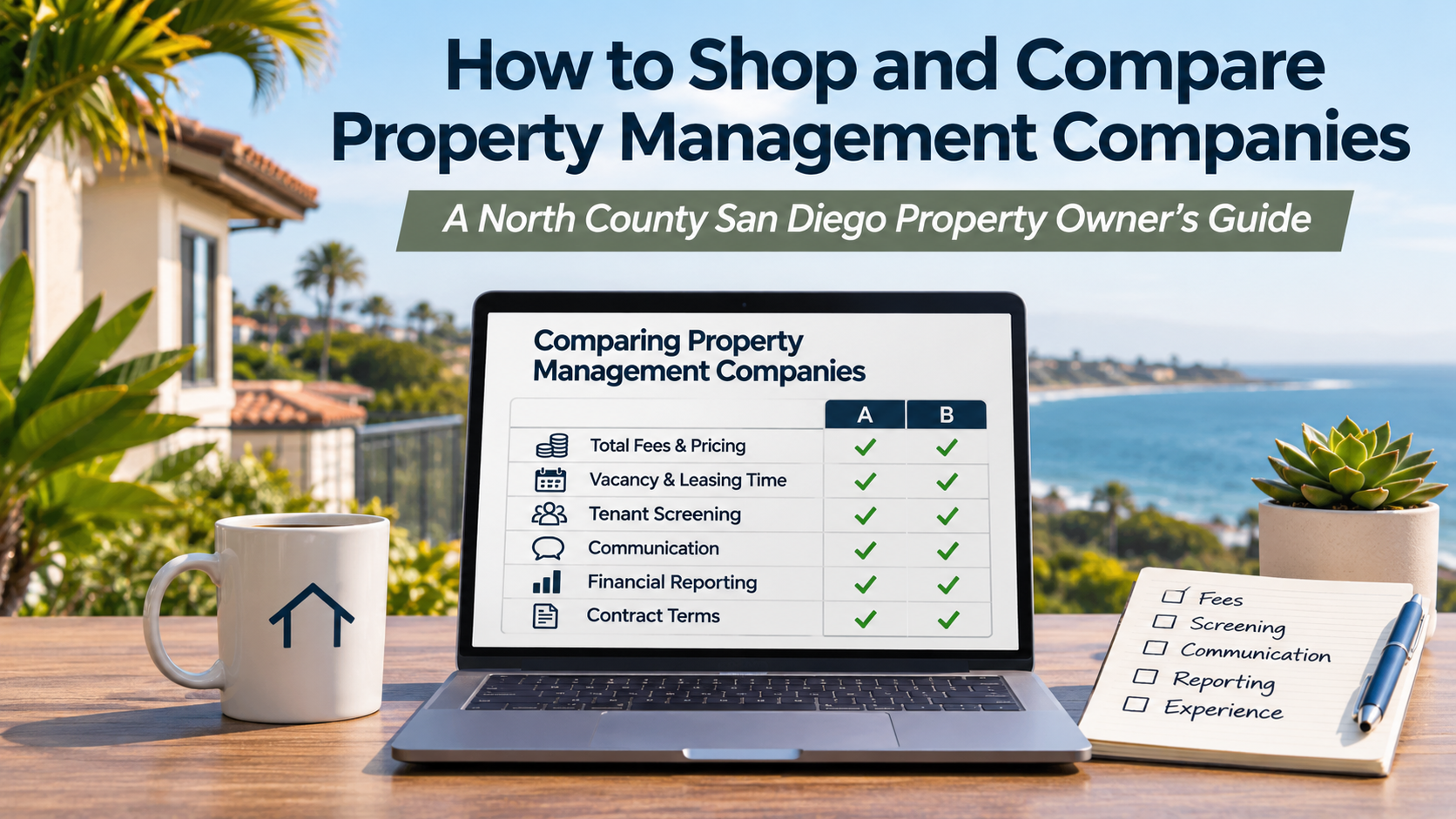
A Practical Way to Compare Property Management Companies
Rather than choosing the first company recommended by Google or ChatGPT, build a shortlist of several qualified candidates.
Include companies discovered through online searches, referrals from other property owners, and professional industry resources.
Then compare each company using the same criteria.
| Evaluation category | What to ask |
|---|---|
| Vacancy performance | What is your typical turnover vacancy period? |
| Tenant screening | How do you verify applicant qualifications? |
| Communication | How often will I receive updates? |
| Financial reporting | Can I see sample owner statements? |
| Maintenance | Who coordinates repairs and approves expenses? |
| Experience | How many properties do you manage? |
| Licensing | Can I verify your active DRE license? |
| Contract terms | What happens if I terminate management? |
| Pricing | What is the total annual cost, including additional fees? |
Once you've completed the interviews, review the companies based on the quality of their answers.
Don't simply award the contract to the lowest bidder.
Look for the company that demonstrates the best combination of operational competence, transparency, responsiveness, and value.
Whenever possible, speak directly with property owners who currently use the company.
A candid conversation with an existing client can provide valuable insight into what the management relationship is really like.
An Illustrative Comparison: Two North County San Diego Rental Owners
Consider two hypothetical owners with similar rental properties.
Owner A: Chose the Cheapest Property Manager
Owner A selected a company based on its low monthly management fee and impressive online rating.
Unfortunately, the property sat vacant longer than expected, communication was inconsistent, and additional fees increased the actual cost of management.
The initial savings quickly disappeared.
Owner B: Chose Based on Systems and Performance
Owner B interviewed several companies and compared tenant screening, vacancy management, maintenance procedures, financial reporting, and communication.
Although the selected company charged a slightly higher monthly management percentage, its processes helped the owner manage the property more efficiently.
The owner also had better visibility into property performance and expenses.
These are illustrative scenarios, not actual client results.
The lesson is straightforward: A low management fee doesn't guarantee a lower total cost of ownership.
The Bottom Line: Hire a Property Manager, Not a Search Result
AI tools, Google searches, and online reviews can be helpful starting points when researching property management companies.
But they shouldn't replace your own evaluation.
Your rental property is a significant investment, and the company you hire can directly affect its financial performance and long-term condition.
Focus on the factors that truly matter: minimizing unnecessary vacancy, screening tenants consistently, maintaining your property, communicating effectively, providing transparent financial reporting, and offering a clear management agreement.
Price should be part of the conversation—but never the entire conversation.
Why Consider FPM Group Property Management?
At FPM Group Property Management, we take a hands-on, locally focused approach to residential property management throughout North County San Diego.
Based in Carlsbad, we serve property owners in communities including Carlsbad, Encinitas, Oceanside, Vista, San Marcos, Solana Beach, Del Mar, Escondido, Cardiff, and Rancho Santa Fe.
Our approach combines local market knowledge, modern property management technology, structured tenant screening, and direct communication.
We understand that property owners aren't simply looking for someone to collect rent.
They're looking for a reliable partner to help protect their investment, reduce the day-to-day responsibilities of being a landlord, and make informed decisions about their property.
We encourage owners to ask us the same questions outlined in this article.
Ask about our screening process, fee structure, maintenance procedures, owner reporting, and how we approach reducing vacancies.
Then compare our answers with those of other management companies.
We believe an informed property owner is in the best position to choose the right management partner.
If you're considering professional property management in North County San Diego, we'd welcome the opportunity to discuss your property and explain how FPM Group can help.
Visit www.fitchpmg.com to learn more or contact FPM Group Property Management.
Frequently Asked Questions
Is the cheapest property management company the best choice?
Not necessarily. A low monthly management fee may be offset by higher leasing fees, maintenance markups, renewal charges, or extended vacancies. Compare the total annual cost of management and the quality of service.
How much do property management companies charge in North County San Diego?
Property management companies may use percentage-based, flat-fee, or hybrid pricing structures. Costs vary depending on property type, services included, and the company's fee schedule. FPM Group's standard monthly management fee is 8%, with additional services itemized separately.
What's the most important question to ask a property manager?
One of the most revealing questions is how long properties typically sit without rental income during tenant turnovers. You should also ask about screening, communication, maintenance, financial reporting, and termination terms.
Should I trust AI-generated property management recommendations?
AI recommendations can be useful for identifying companies, but they should not be your only source of information. Interview multiple candidates, verify licensing, read detailed reviews, and speak with existing clients when possible.
How can I verify that a California property manager is licensed?
Use the California Department of Real Estate's public license lookup to verify the responsible broker and applicable salesperson licenses.
What should a property management company provide each month?
Owners should generally expect a financial statement showing rental income, management fees, maintenance expenses, and distributions, along with access to supporting information and relevant property updates.
What should I look for in a property management agreement?
Review the management fee, leasing fees, renewal fees, maintenance charges, contract duration, termination provisions, and financial reporting requirements. Make sure the agreement clearly explains the responsibilities of both parties.
Research and References
The following sources informed the research and guidance presented in this article.
Airgood-Obrycki, W. (2026). The Fragmentation and Concentration of Property Management in US Rental Markets. Harvard Joint Center for Housing Studies.
U.S. Bureau of Labor Statistics — Property, Real Estate, and Community Association Managers.
California Department of Real Estate — Quick Guide for Landlords Hiring a Property Manager.
Iyengar, S. S., & Lepper, M. R. (2000). When Choice Is Demotivating: Can One Desire Too Much of a Good Thing? Journal of Personality and Social Psychology, 79(6), 995–1006.
Adapted with permission from the original article, “How to Shop and Compare Property Management Companies (Without Letting AI Pick for You),” published by Rincon Property Management on September 9, 2026.
About FPM Group Property Management
FPM Group Property Management is a Carlsbad-based residential property management company serving North County San Diego. FPM Group specializes in helping rental property owners navigate tenant placement, leasing, maintenance, rent collection, and ongoing property management with a focus on communication, transparency, and long-term investment performance.
Website: www.fitchpmg.com